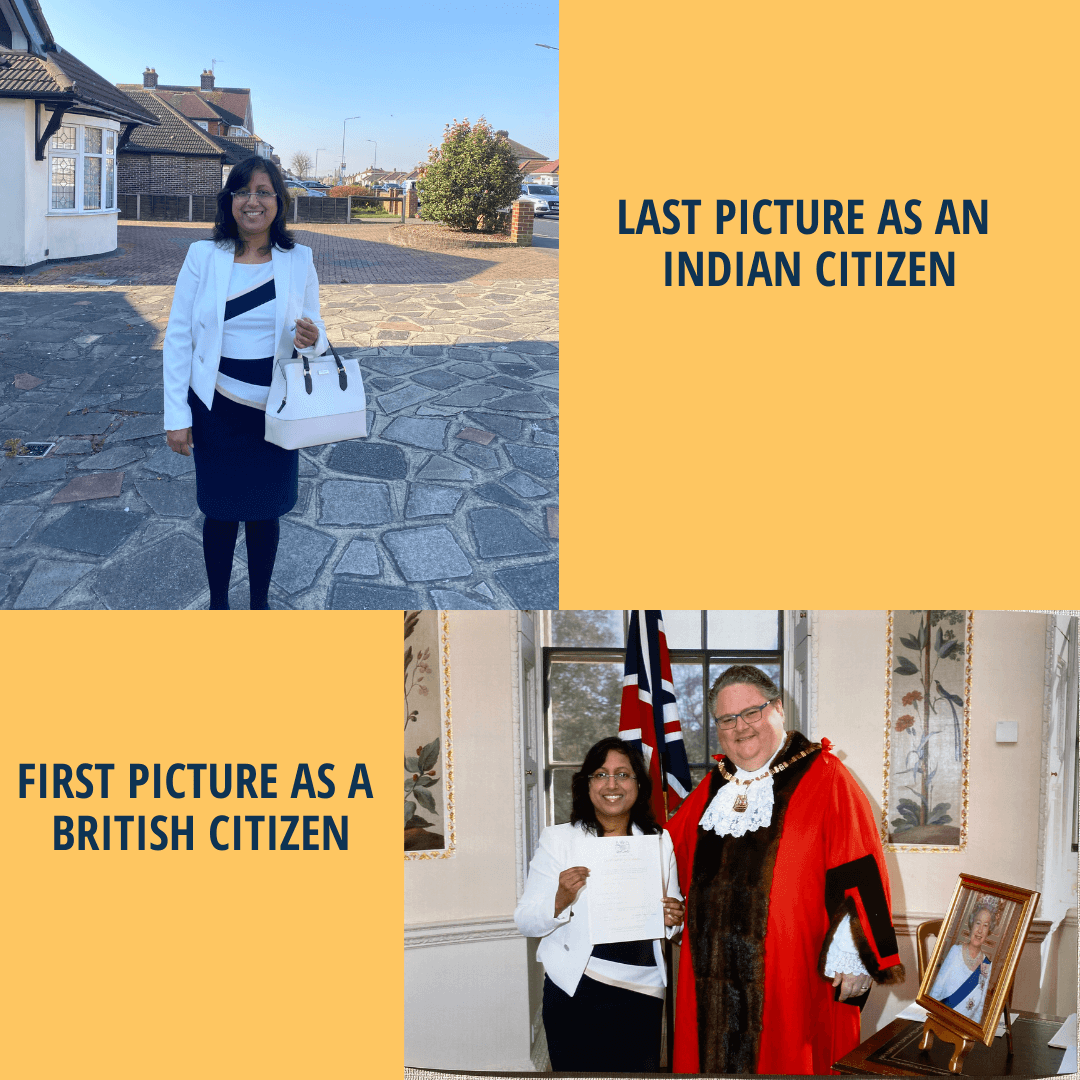
This picture captures my journey across borders and stories.
It took 11.5 years, 15ishK pounds, a 6 steps-process plus a solicitor.
But I got there.
‘Where?’ you might ask.
Becoming a naturalised British citizen.
Like all Indians who choose a different citizenship, I made the choice to surrender my Indian citizenship. While inching towards this long process, I occasionally reflected on it. This blog captures some of those reflections.
I think this blog will speak to you irrespective of whether you live in a country different from your country or birth. I am sure you will find threads of your story in mine and relate to what I have to say in some form and shape.
1. The journey may look similar but never is.
It took me double the investment in terms of time, energy and money to reach there as compared to other people who come from where I come. Yes, our journeys towards the finish line (naturalisation) may have looked similar but weren’t.
Lesson: Isn’t thats how it is in every aspect of life?
2. I took longer because I made a mistake in the process.
Oh no! I hear you exclaim, my lovely well-wisher.
Thank you! 😍
Lesson: Actions have consequences. Simple!
3. Not all mistakes are bad.
Some mistakes have the power to save your life. The mistake I made in this process literally saved my life. Of course, I didn’t know that when it happened; I figured it out a few months later.
Lesson: Connecting the dots as we look back is delicious because it gives us 20/20 vision.
4. Romanticising and glorying mistakes, are we?
Nope! It is the truth.
It has a looong backstory. Pour yourself some tea or coffee or water and travel with me to the summer of 2012.
I had been in the UK for 20 months and my first visa renewal was imminent. I was changing visa categories. According to the rules back then, you could only change visa categories from your country of origin.
This meant that I would have needed to go back to India to get my new visa processed and return to the UK. The process can take anywhere between 4 weeks to several months. I kept reading under guidelines on the application form that to renew a visa in the same category, you can apply from within the UK.
But I could not infer what needs to be done when you change visa categories. I just couldn’t. The words didn’t get in.
Result? I applied locally at Cambridge and my visa to live and work in the UK got rejected.
An expensive mistake in terms of stress, time and money. We lost money as the visa application fee is non-refundable. We hired a solicitor because we were in trouble. About 5K went down the drain immediately.
Except it wasn’t as expensive as it could have been if I had got it right.
If I had interpreted the requirement to renew my visa from India correctly, I would have travelled to India for it. Obviously! But it needed to be done at the exact time when I was diagnosed with cancer.
When I was diagnosed with aggressive breast cancer in September 2012, the doctors had said that a delay of even 4 weeks could have completely changed my prognosis; there was a strong possibility that they wouldn’t be able to help me at all.
If I were in India, my diagnosis and treatment would have been delayed by a couple of months because both the events, diagnosis and visa renewal overlapped.
A couple of months? I didn’t have them spare! Not in late 2012.
By the time the rejection on my visa application came in, I was in the thick of chemotherapy, and was very poorly. There was no chance I could travel without risking my life.
We appealed the decision through a solicitor and the authorities listened. I was able to stay so my treatment wouldn’t get interrupted.
However, my visa cycle was reset and that is why instead of the usual 6 years, I took just under 12 years to reach the finish line. Another couple of thousands of pounds got added as the initial investment would not be considered.
Lesson: Keep your eyes on the big prize, everything else is part of the process.
In this whole process, we had only one priority. Being able to go through cancer treatment uninterrupted because it would have made the difference between life and death. Yes, spending an additional 7K hurt but what is 7K as compared to life? The very comparison is ridiculous! 😅
I am awed at and grateful for that one mistake because it saved my life.
5. People are kind and they want to help.
I know it is easy to be disgruntled with the expenses, the delays and the systems but people want to help when they can.
I am grateful for the authorities who listened and granted their decision in my favour even without a tribunal hearing. I am grateful for my doctors who supported me with the paperwork. I am grateful for my oncologist who even put in place a plan B by finding me a trusted oncologist in Mumbai who could look after me if I had to leave.
Lesson: People are good. We must never lose sight of their goodness.
6. Being on this journey meant, I had choices and decisions to make.
India does not allow dual citizenship and therefore, I always knew that I would need to make a decision on whether I wanted to retain my Indian citizenship or be a naturalised British citizen.
Lesson: There are fewer things more liberating than having a choice. Not everyone has a choice. I plan on savouring the choices I have.
7. Change of identities
I have pondered on how our identities are rooted in where we come from and what it means when we get a new piece of legal paper. The truth is that I have not felt any different in the last 2 weeks. I do appreciate that as we move through generations, these identities and their corresponding stories will change.
Lesson: Our identities are defined by our stories. But neither are cast in stone. They both change and evolve.
8. But what of history?
A friend had asked me if I would change my citizenship when the time comes.
Depending on where your roots are on the world map, what colour your skin is and who your government has allies with, you would have read a certain version of history. But despite the versions and nuances of stories you may have read, the truth is that the two countries, India and Britain share a common history and a lot of it isn’t pretty.
So, would I?
Yes, I would.
I appreciate all the ancestors who came before us and what they had to do to ensure that someone like me gets to write their views freely. They made way for me and countless others to thrive in a free world. I am grateful for that. I really am.
But history represents the past. My hope is that we human beings are able to learn from it and find forgiveness and love for each other at all levels.
Lesson: The past is a concrete evidence based opportunity to learn. But it does not have to equate our present and the future.
9. Isn’t finding love & forgiveness for our own kind enough?
Yes, it is. Except I invite you to consider what our own kind means.
I dream of a world where borders serve only academic purposes. The lines are drawn on maps to appreciate our beautiful world and not to divide people.
ईश्वर की कलाकारी नहीं,
मनुष्य की चित्रकारी है,
कभी रंग, कभी रूप, कभी देश,
कभी जाति, कभी धर्म के नाम पर,
जीवंत होती लकीरें।
In this verse from one of my poems entitled लकीरें or lines (representing borders/divisions), I am saying,
It is not God’s art
But human’s
Colour, or looks, or country,
Caste or religion,
In these names, the lines appear.
लकीरों का अस्तित्व
उचित मात्र भूगोल के लिए
पर्वतों-नदियों में सिमटी रहें
घृणा जोड़ के, नियति फोड़ के
हमारे हाथों में ना समा पाएँ।
The identity and purpose of these lines
Is appropriate for geography
It is better if they are limited to mountains and rivers (on maps),
By bringing our kind together through hatred (for the other kind)
We must ensure that they
Do not sit on our hands and
Dictate our destiny in a warped sense.
The reference is to the Eastern belief that the lines on our hands foretell our destiny.
Lesson: The lines, even the ones foretell our destiny, do not need to divide us. That choice lies within us.
10. What’s the bottomline?
We must acknowledge and accept the history and our past stories in their entirety: The good, the bad and the ugly.
We must celebrate the good.
We must learn from the bad and the ugly.
My hope is that we are able to look at the whole story objectively and lovingly and not just the parts that hurt us. Acknowledging the past for me is as important as celebrating how beautifully I have been accepted and loved by the people I live amongst.
I belong here. I have neighbours, friends, colleagues, clients and a community who are British. I celebrate them all, wholly and lovingly.
The UK is my home. So is India. I may have had to choose one over the other on paper but they are both part of my story and will always be.
My desire is that at some point in our lives we find forgiveness and the courage to change our narratives. Changing the narrative does not mean that we do not value the past; it only means we are choosing that the past does not dictate or distort the future.
I dream of a world where we are able to look beyond the seen and the unseen factors that divide us. That we are able to see all human beings as our kind. That we own our identities and stories, whilst staying true to ourselves and without allowing them to divide us.
Lesson: I must play my part to make that happen. So, I’ve changed a part of my identity by changing my internal narratives and choosing to look beyond the stories that divide us.
My question to you is: Will you join me in my vision to build a world without borders? The steps for you may look different from mine but will you?
#wetellstories #storycoaching #naturalisation #personaldevelopment
Need a hand to change your narratives and internal stories, so they work for you? Book a free call here.
Love this post Parul
Thanks, Sumi. 😇
How are you? Hope that you are doing well.