
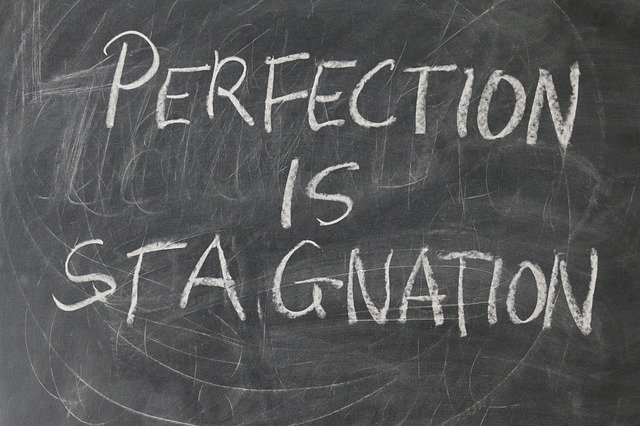
Image by Gerd Altmann on Pixabay
Perfectionism isn’t unicorns and rainbows. Nor is it the secret ingredient that propels high achievers forward either. On the contrary, it can stagnate your career progress, well-being and happiness.
In this blog, I want to deep-dive into how perfectionism can get in your way and how we can make sure that our desire for perfectionism works for our benefit.
I wore the label of ‘a perfectionist’ like a badge of honour. I took pride in being one. When I was growing up, perfectionism was rewarded as a behaviour. I lived like a proud perfectionist poo-pooing less than perfect things for over three decades until I was diagnosed with cancer in the week of my 34th birthday.
Why mention cancer amidst perfectionism?
Simple! A brush with mortality brought in loads of perspective.
Cancer was not a usual experience for me. It was an intense crisis that stopped me in my tracks and forced me to live differently. I remember that during the treatment and for about a year afterwards, I was left almost in a vegetative state. I had little strength and my mental health was fragile. The benchmarks of what I could do and how well I could do those things changed. I could no more be the perfectionist I knew myself to be.
My new focus was doing just enough to survive (oh, the irony because we are talking about cancer) and not aspire for perfectionism.
I wanted different things from life after cancer. I decided to change my career direction and qualify as a coach. During my coach training, my jaw fell to the ground as I learned that perfectionism was not a badge of honour. Instead, it can be a serious impediment to our well-being and progress.
Perfectionism is a trap that can hinder your career success and happiness.
Let’s explore its impact and what we can do about it.
1 – Perfectionism leads to stress
“Shoot for the moon. Even if you miss, you’ll land among the stars.” – Les Brown
Ever heard that? I am sure you have.
Shooting for the moon is akin to setting stretched goals. Stretched goals are great because they push us out of our comfort zones. I see them as drivers for evolution. All major inventions must have been conceived as ideas and were followed through because people had set stretched goals. As an avid traveller, I love being able to hop on a flight and travel from one continent to another but I can do it because somebody conceived the idea of being able to fly several decades ago.
But the question here is: What happens when you aim for the moon but actually land in the stars?
Is landing in the Stars a stepping-stone for something bigger you’re working towards or is it, “Damn! I failed again. I’m stupid. I’m not good enough. I’ve done it again”? Do you view it as feedback or do you view it as failure?
Perfectionists do the latter. They tend to view landing in the stars as failure.
Result? An abnormally high level of stress because they haven’t achieved their perceived idea of perfection.
As a talent manager, I had the opportunity to work with some of the best minds in the industry. What baffled me was seeing how those high-achievers were doing fabulous work and were getting recognised and rewarded for it and yet, some of them were a grumpy lot with little job satisfaction.
With the benefit of hindsight, I can see that one of the reasons why they were dissatisfied was they saw themselves as landing in stars while they were shooting for the moon.
Lesson: Perfectionism as a driver is great but perfectionism as a permanent state is exhausting. It is important to celebrate less than perfect results as feedback and not failure.
2 – Perfectionism hinders action
Fear of not being able to do things perfectly and hence perfectionism can stop you from taking action.
Maybe you are currently in an individual contributor’s role but what you really want is to lead a team because you enjoy mentoring and coaching others. If you decide to apply for that leadership role only after you have the competence to be the perfect leader, you will never be able to do it.
You may be saying no to a more challenging role because you keep waiting to be able to do it perfectly.
Guess when that might be?
Never. Because you will never finish learning.
Lesson: Take the next step. Imperfectly done is better than perfectly not-done.
3 – Perfectionism fools you into thinking ‘You are not ready’
As a perfectionist you may feel that you are not ready.
The reality is that you can never be completely ready, especially when you are in unfamiliar situations or outside your comfort zone because there will be several variables outside your control.
Here is a simple example: You can decide to be a parent but you cannot predict if you would be able to parent your child perfectly. What if your baby does not sleep? As a sleep deprived person, who is responsible for a little human, it would be awfully hard to do everything to your definition of perfectionism.
As a leader, you may stop yourself from going after your big dreams and goals because you do not feel ready.
Lesson: You can never be fully ready to do things perfectly. Yes, it is important to build competence and learn skills but you are as ready as anyone can be now. Work with what you can influence and control and wing everything else.
4 – Perfectionism makes returns incremental
It is important to refine our initial work to ensure high quality but there comes a point where refinement isn’t commensurate with the effort anymore.
It is important to understand what the acceptable level of quality is and go with it, instead of aspiring for the last 0.0001% quality enhancement.
When going through cancer, I met many people who wanted to write and publish their cancer experiences. They also wanted to do it perfectly. None of them ended up doing it because they kept waiting for their writing to be perfect.
If I had adopted a similar attitude towards my cancer memoir, my memoir would be unpublished and it would not have changed thousands of lives all over the world.
Lesson: Don’t burn energy, time and resources for incremental results when you could use them optimally elsewhere.
5 – Perfectionism messes up relationships
Perfectionism can seriously impact your relationships. There are two relationships I want to mention:
(a) The relationship you have with other people, and
(b) The relationship that you have with yourself
As a perfectionist leader, it is easy to project your need for perfectionism on your team and make their lives miserable. I’ve coached leaders who alienated their teams because they thought they were ‘raising the bar’ with their insatiable desire for perfectionism.
As a parent, it is easy to do the same with your children. I’ve seen parents who get paranoid if their child achieves 95 out of 100. Instead of appreciating that they got 95 on 100, the focus is on where 5 were lost.
If you are a perfectionist, nothing or no one will be good enough for you.
By parallel logic, you will never be good enough for yourself because you will always fall short of your perfect utopian standards. Your worthiness quotient and self-esteem can go down in the process.
Lesson: Watch out for the impact your need for perfectionism is having on other people in your life. Be mindful of how it is making you feel icky about yourself.
Final thoughts
1 – As we navigate life, our parameters in life change; we change as individuals, so do other variables. It is important to review the parameters we hold ourselves to and see if they are helping us move forward or getting in our way.
Trying to live today according to yesterday’s parameters may not be helpful.
2 – There is no such thing or person as perfect. Let good be good enough.
3 – Fall in love with the messy process and not just the perfect end result you are aspiring for. If you aren’t enjoying the ride, you may have trouble appreciating the destination.
4 – Look back at your life and consider if chasing or achieving perfectionism really mattered. Does it really matter how perfectly:
- You delivered a project
- You cooked a meal
- You loaded the dishwasher?
Perfection is overrated. Unless your work involves numbers or saving lives. 😇
Let perfectionism be a driver that becomes your strength and not a trap that keeps you stagnated, small and stuck.
#wetellstories #storycoaching #careersuccess #gofurtherfaster
Ready to rein in your perfectionism or whatever is holding you back. Book a FREE call here.
I found this article very informative..for sure my perfectionism has created enertia ..I so want to do something else with my life!
Sue,
Well done on recognising that your perfectionism is getting in your way. The good news is that perfectionism can be unlearned. 🙂
Let me know if you would like some help. Happy to offer a conversation and brainstorm some ideas.