

Picture by Abigail Keenan on Unsplash
Learn three powerful approaches to beat overwhelm: Written specifically for busy corporate leaders for helping them succeed with ease and without losing their mental peace and sanity.
As a mid-to-senior level leader, working for one of the top consulting organisations, do you resonate with any of the following?
👉🏽There is pressure to perform at a high level consistently.
👉🏽You must create and maintain a place for yourself amongst equally talented high-achieving individuals. Slacking off isn’t an option.
👉🏽You must learn how to navigate corporate life, without getting sucked into politics, system and rat race.
👉🏽Having a life outside work takes effort because you have little time and energy left.
👉🏽The travel that accompanies glamorous Consulting jobs is exhausting as you move from one airport to another, one 5 star hotel to another, across countries.
There are times when you must do ALL of these in parallel!
Result?
Overwhelm!
Why wouldn’t you feel overwhelmed? Of course, you would.
Overwhelm doesn’t happen only to the disorganised or the wimps. It impacts us all.
Learning how to tackle overwhelm is important, otherwise it can swallow us whole. (Ooh, that rhymes!)
In this blog, I want to share with you three approaches to tackling overwhelm.
Approach 1: Being aware that overwhelm is approaching
Like everything else in life, the first step to helping ourselves is being aware of what is going on.
In recent years, I have developed a huge liking for Donald Rumsfeld’s quote, “You don’t know what you don’t know”. It does not mean ‘ignorance is bliss’.
I find it witty, deliciously ironic and a whack-in-the-face. Wisdom delivered how I like it.
To be able to deal with overwhelm, we need to identify and acknowledge that we are overwhelmed. We cannot tweak, reset, improve, or get rid of what we do not know exists.
Being open to the idea that you may be experiencing overwhelm is a good start.
Why?
Because so many of us want to believe and show that we have all our sh#t together. But the truth is, we all lose our sh#t occasionally and it is OK.
I would be suspicious of a human who claims they have everything under control, all the time. LOL!
To tackle ‘You don’t know what you don’t know’, The Johari Window model is brilliant. It was developed by Joseph Luft and Harry Ingham in 1955 and has several applications, including building self-awareness. Like any other model, Johari Window isn’t perfect. It does not cover all permutation-combinations of human choices but remains a good model for an overview.
The Johari Window has the following four quadrants:
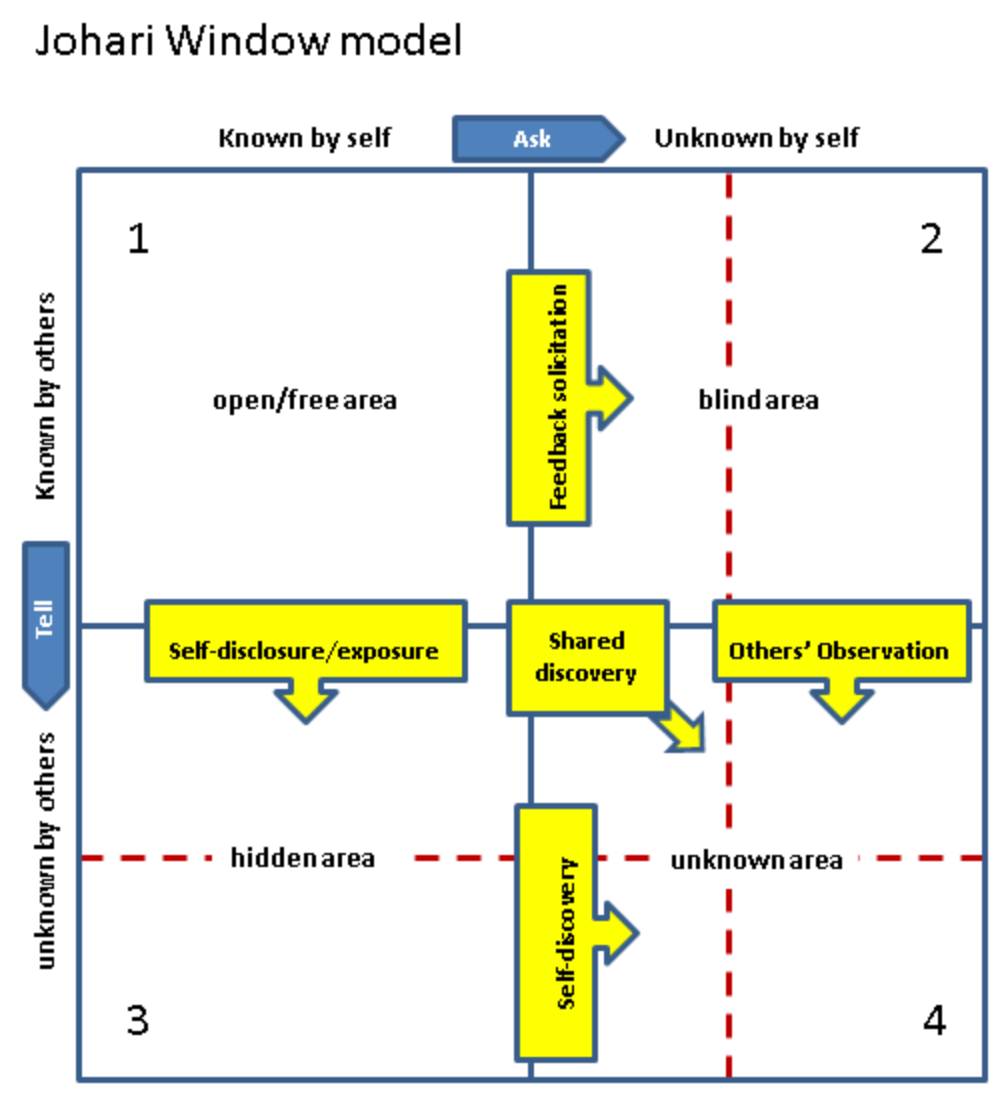
(Source: https://www.selfawareness.org.uk)
Quadrant 1: Known by self + Known by others – Open Area
Quadrant 2: Unknown by self + Known by others – Blind area
Quadrant 3: Known by self + Unknown by others – Hidden Area
Quadrant 4: Unknown by self + Unknown by others – Unknown area
Feedback helps to reduce our blind spots as others can see and tell us what we do not know.
Sharing information with others reduces our hidden area and increases the open area.
Discoveries, by self or as shared experiences and others’ observations bring to light the unknown areas no one knows about.
When we want to increase our understanding of self, asking questions helps.
If we want to reduce information unknown by others, volunteering information helps.
Awareness of which quadrant we fall into with respect to a certain behaviour can clarify the next step for us.
e.g. I may have the view that I do not get overwhelmed when life throws a curveball at me. Seeking feedback from people I trust will confirm if my opinion is valid. If my behaviour isn’t consistent with my view of self, it indicates a blind spot.
If neither they nor I know if I get overwhelmed, it is an opportunity to do some self-discovery. Mindfulness is a great vehicle to notice what’s going on, followed by journaling for record keeping and deep diving into what we notice.
If I am feeling overwhelmed but keeping it under wraps and hidden from everyone, volunteering information about how I am feeling will reduce my hidden area. Asking for help and letting others help us falls into this category.
See how it works?
Exercise: Go on, grab a pen and a paper and do a Johari window for yourself.
Approach 2: Knowing our priorities
Knowing our priorities brings our options to the fore and enables us to tackle overwhelm.
Stephen Covey’s time management matrix (from his book ‘The Seven Habits Of Highly Effective People’) is my absolute favourite tool for getting my priorities right.
 (Source: https://www.franklincovey.com/habit-3/)
Quadrant 1: Important + Urgent.
Fire. Must be extinguished now. Definitely qualifies for ‘do’.
Quadrant 2: Important + Not Urgent.
Planning, gaining knowledge, building competence and self-care fall in this category. Qualifies for ‘do’.
Quadrant 3: Not Important + Urgent.
These tasks are tricky because they look important but aren’t (to us).
Responding immediately to emails falls in this category. Delegate or drop. Try not to get pulled in.
Quadrant 4: Not Important + Not Urgent.
As this quadrant illustrates, these tasks are neither important, nor urgent. They add little value. Dropping them will free up our resources and time.
Social media addiction, aiming to achieve the final 0.0001% improvement in quality for perfection falls in this category.
I had a client who was addicted to browsing prices for e-commerce products. He would do it for several hours every day regardless of whether he wanted to buy them or not. Identifying this behaviour showed him how to free up a huge chunk of time.
When facing overwhelm, consider which quadrant that task belongs in and act accordingly.
Of course, all situations wouldn’t neatly sit in the four quadrants. When something is important but not urgent but is left for too long and is now pushing us hard against a deadline, it also becomes urgent. It shifts from quadrant 2 to quadrant 1. It is important to keep an eye on quadrant 2 to prevent its contents from spilling over into quadrant 1.
Exercise: Draw a 2 * 2 matrix and apply Stephen Covey’s time management concepts. Plot your activities and see where you might be leaking out time through Quadrant 4. When you know, stop doing those tasks.
Approach 3: Explore where you may be overwhelming yourself
There are times when overwhelm happens to us because there is so much going on or life happens.
However, it is easy for us to overwhelm us.
Do you know people who say yes to everything and then get overwhelmed because it is impossible to cater to everything they have taken on? Lack of assertiveness, people-pleasing, poor boundaries, going to excess are typical reasons to say yes to everything.
Learning to be assertive to say no will help against taking on too much.
Exploring why you might be people-pleasing and how to change this behaviour will help you come out of this vicious cycle.
Knowing and respecting your boundaries will support you with assertiveness.
Identifying unhealthy behaviours such as choosing excess over balance will bring in respite from overwhelm.
Coaching is a powerful vehicle to identify and change unhelpful behaviours. It is hard to make these changes ourselves as we do not see the full picture.
Conclusion
(Picture of iceberg: Simon Lee on Unsplash)
Remember that overwhelm is a symptom; we are the ones feeding it with our choices.
Overwhelm is only the tip of the iceberg; we are the iceberg. If we want to rein in overwhelm for real, we must focus on the iceberg.
#overwhelm #careersuccess #personaldevelopment #gofurtherfaster
Need a hand to deepen your self-awareness by uncovering your blind spots, figuring out your priorities and exploring how you may be playing a key role in overwhelming yourself?
Book a free call here.